
Diamond Bar Public Records Inventory
Most Diamond Bar public records are county-run because the city is inside Los Angeles County and incorporated in 1989. The City Clerk handles local records and public-records requests. The RR/CC maintains recorded real estate documents, vital records, fictitious business names, and elections. The Assessor runs parcel searches. The Superior Court manages case access. State systems add license, business, UCC, prison, offender-registry, and unclaimed-property records.
| Record set | Custodian | Online index | Coverage | Access |
|---|---|---|---|---|
| Deeds and real estate records | LA County RR/CC | No official public internet index | 1850/1851 forward | Office index, copy request, mail or in person |
| Fictitious business names | LA County RR/CC | Yes | Online name search Apr. 2011, open data Feb. 2024 | Search by business, city, ZIP, and more |
| Assessor parcels | LA County Assessor | Yes | Current parcel roll | Free portal, owner names withheld online |
| Civil, family, probate, small claims | LA Superior Court | Paid name search | 1983, 1991, or 1992 forward by case type | Portal search, document fees, archives for older files |
| Vital records | LA RR/CC and CDPH | Application portal, not browse index | County and state ranges vary by event | Authorized or informational copies |
| Voter registration | LA RR/CC and SOS | Verification only | Current and historical routes | Restricted by election law |
| City permits and licenses | City of Diamond Bar | Records library | Permit archive, business licenses July 2017 forward | Online library or CPRA request |
| Custody and offender lookups | LASD, CDCR, DOJ | Yes | Current public subsets | Free lookup with legal-use limits |
Public access does not mean every record is open online. Sealed court records, juvenile records, protected voter records, confidential marriage copies, DMV data, Social Security numbers, signatures, ID numbers, and Safe at Home addresses are restricted or redacted.
LA Recorder Public Records Gap
Los Angeles County RR/CC is the recorder for Diamond Bar deeds, liens, and other recorded real estate instruments. The office states that real estate records are maintained from 1850 or 1851 forward. Its public web pages also state that real estate records and indexes are not available through the internet. Instead, 1851 to 1957 records are reviewed on the lower level at Norwalk Headquarters, and 1958 to present records are reviewed on the second floor.
That gap shapes Diamond Bar public records research. A researcher can use Assessor and city GIS tools to verify a parcel, then use RR/CC office review or copy requests to obtain recorded instruments. Property records are indexed by grantor, grantee, and recording year. The office does not accept phone requests for index searches, so a known document number, date, party name, or year range can save time and search fees.
| Recorder route | Search mechanics | Fee or limit | Best use |
|---|---|---|---|
| Norwalk office review | Alphabetical index by name and year | Viewing is free | Grantor-grantee research |
| Staff search for copy request | Name and year search | $0.50 per name per year, $1 minimum | When document data is incomplete |
| Plain copy | Copy by document | $5 first page, $3 each additional page | Uncertified reference copy |
| Certified copy | Certified by RR/CC | $6 first page, $3 each additional page | Official copy need |
The LA County recording and copy fee schedule is the source for copy and search costs.
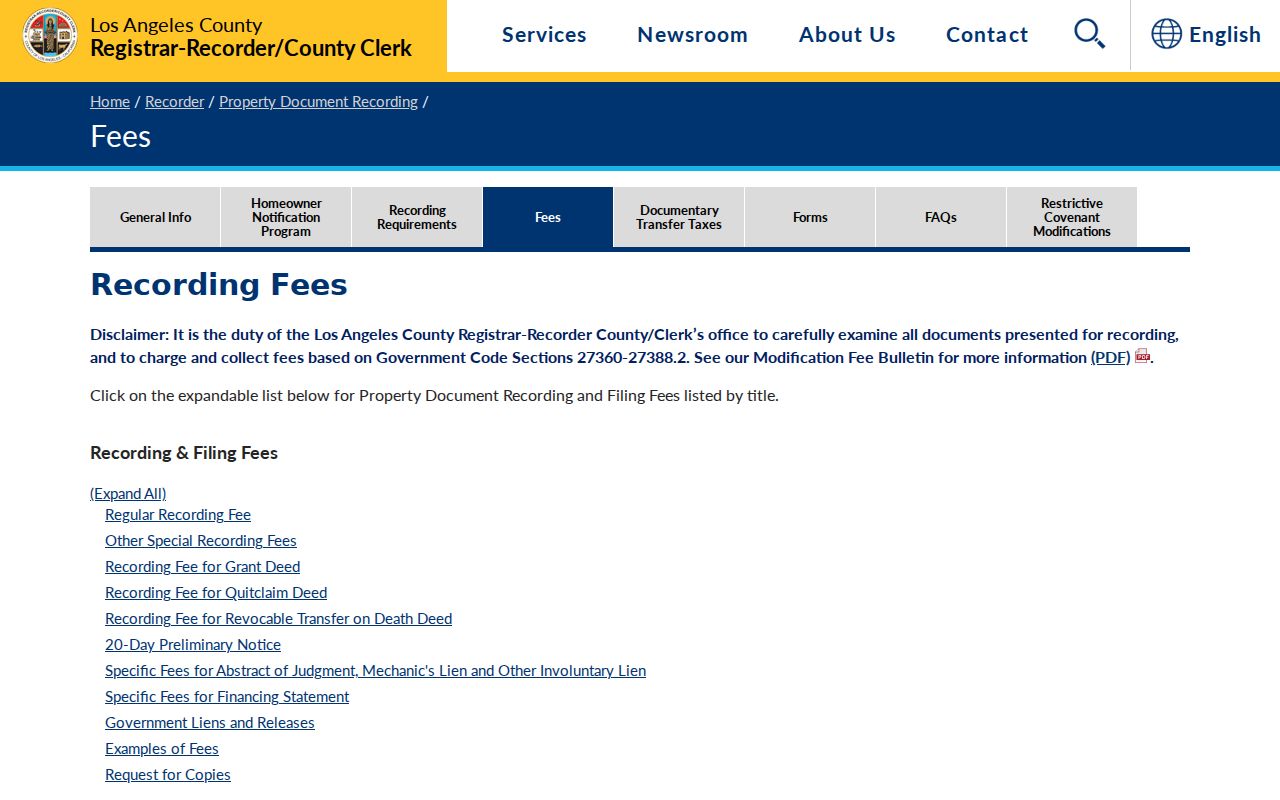
Fee pages matter because a broad name-and-year request can cost money even when no match is found.
Diamond Bar Public Records Portals
The main public records offices serving Diamond Bar split by record type. The city handles its own CPRA intake and records library. RR/CC handles county recorder, clerk, vital, FBN, and elections records. The Assessor handles parcel data. LASC handles court files and online name searches. LASD and CDCR handle custody records, and California DOJ controls the Megan's Law public registry.
Assessor Records Without Names
The Los Angeles County Assessor Portal searches by AIN or address and by assessment legal description. Results can show AIN, situs address, legal description, use type, values, building details, tax rate area, zoning, and sale or ownership-change events. The public portal does not post owner names or owner mailing addresses. The Assessor points users to in-person district-office access or Property Data Sales for owner information.
Diamond Bar's own GIS parcel viewer also supports address and APN searches and exposes local fields such as zoning, general plan land use, school district, HOA, council district, fire zone, trash day, street-sweeping schedule, and parcel facts. It is a strong parcel-context tool, not an owner directory. Use it to normalize an address before a public records request or recorder copy search.
The Los Angeles County Treasurer and Tax Collector duplicate bill lookup is the tax-bill side of the parcel record chain.
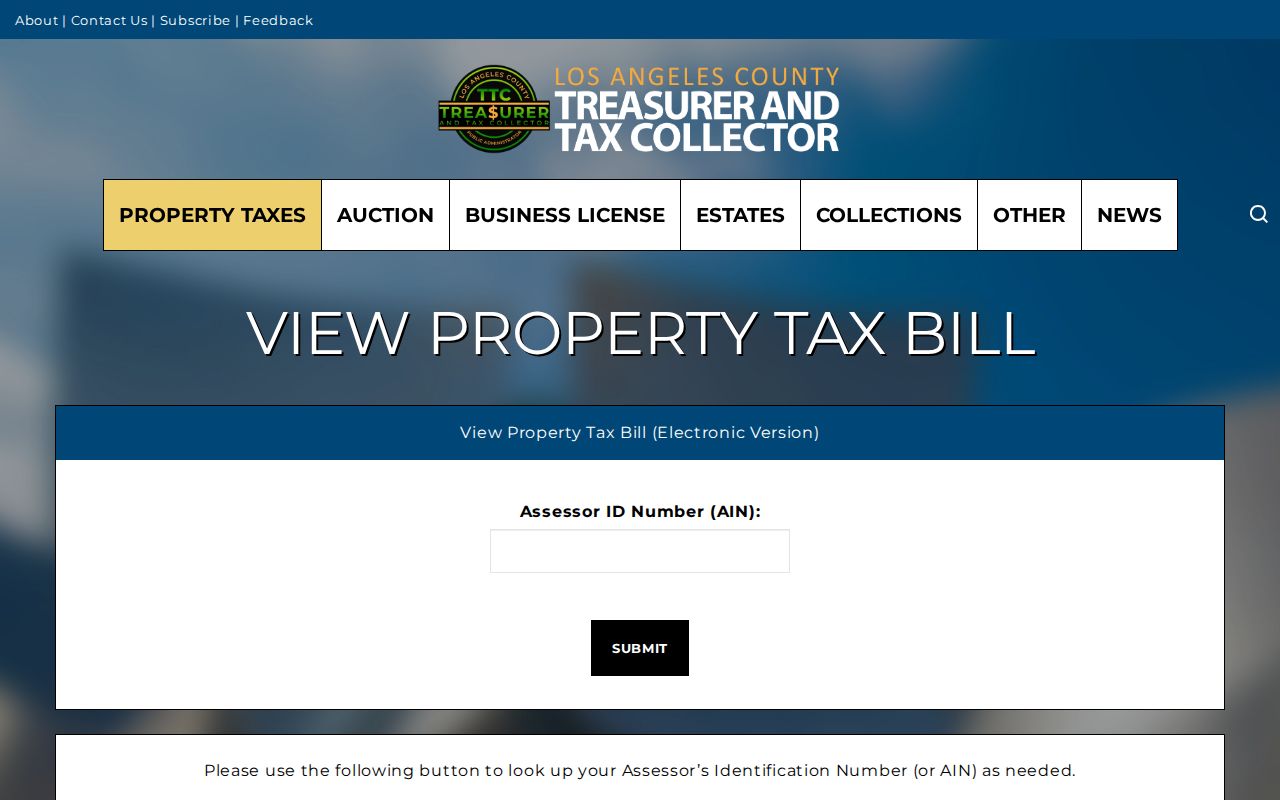
Tax-bill tools are AIN-centered, so they help after the address has been normalized in the Assessor or city GIS system.
| Field label | Type | Required | Notes |
|---|---|---|---|
| Search by AIN or Address | Search/autocomplete | Optional, needed to query | AIN should be 10 digits, address text accepted |
| Search by Assessment Legal Description | Text search | Optional | Separate search mode |
| AIN | Text | Optional | Four-digit map book, three-digit page, three-digit parcel |
| Address | Text | Optional | Situs or street address |
| Legal Description | Text | Optional | Assessment description, not always the full recorded legal |
Diamond Bar Court Records Access
Diamond Bar court records are maintained by the Superior Court of California, County of Los Angeles. The civil, small claims, family, and probate name search uses a paid party-name index. Results can show litigant names, case type, filing date, filing location, and image count. The court help material lists coverage from 1983 for family, probate, and unlimited civil, 1991 for limited civil, and 1992 for small claims. Criminal index coverage begins in 1980 for felony cases and 1988 for misdemeanor cases, with some older misdemeanor index data depending on the former municipal court system.
Remote access is not the same for every case. Sealed and confidential records are excluded. Some family, juvenile, guardianship, conservatorship, mental health, and criminal proceeding materials may require courthouse-only electronic access under California court rules. Older cases may need Archives and Records Center help.
| Search field | Type | Required | Format note |
|---|---|---|---|
| Litigant name | Text | Yes | Civil, small claims, family, and probate name search |
| Case category | Database scope | No | Civil, small claims, family law, probate |
| Login mode | Account or guest | Yes | Guest or registered user |
| Payment | Payment workflow | Yes | Required before paid results |
Vital Records Copy Rules
Diamond Bar birth, death, and marriage copies route through Los Angeles County RR/CC or CDPH, depending on event, year, and request path. LA County's BDM application portal handles birth, death, and marriage certificate requests. Same-day immediate copies and mailed-copy ranges differ by event. The research file located LA County fees of $34 for birth, $26 for death, and $19 for marriage copies. Fees are nonrefundable, and a no-record statement may be issued if no record is found.
Health and Safety Code section 103526 controls the authorized versus informational copy split. Authorized certified copies require the requester to be an eligible person and complete the sworn or identity-verification step. Other requesters may receive informational certified copies for birth, death, and nonconfidential marriage records. Confidential marriage records are limited to parties or persons authorized by law. Divorce decrees are court records, not county clerk certificates.
- Certified copy
- A copy certified by the custodian, often with eligibility rules or notarized identity steps.
- Informational copy
- A marked copy that can support research but is not valid to establish identity.
- Custodian
- The agency that keeps the record and has authority to release, certify, or withhold it.
- Exemption
- A legal reason a public agency may withhold all or part of a record.
City Permits and Licenses
Diamond Bar's Online Records Library is the city-level public records source with the most local detail. It includes building permits organized by street and address number, business license reports from July 2017 forward, City Council records from 1989 forward, city commission records from 2010 forward, finance records from 1989 forward, and previous Public Records Act requests for two years under the adopted retention schedule.
Permit records are important because the sample research showed owner names, contractor names, APN, worksite address, scope, fees, inspection checklists, declarations, and signatures in archived permit PDFs. Business license reports can identify local business activity. Code-enforcement notices may include owner, address, officer, violation, code citation, reinspection, and lien-related facts when disclosed.
Access caution. A public record may contain private facts or redacted fields. Use Diamond Bar public records for lawful research and verify important facts with the custodian.
Request Diamond Bar Public Records
The California Public Records Act is codified at Government Code section 7920.000 and following. Government Code section 7922.535 gives an agency 10 days to determine whether it has disclosable records, with a possible 14-day written extension for unusual circumstances. Government Code section 7922.530 requires nonexempt identifiable records to be made promptly available after payment of direct duplication costs or statutory fees.
- Identify the custodian before filing. City permits go to Diamond Bar, deeds to RR/CC, cases to LASC, and parcels to the Assessor.
- Check posted portals first, including the city records library, court access hub, assessor portal, and RR/CC pages.
- For city records, use the Diamond Bar PRR form with enough detail to identify the record.
- Pick the delivery method: email copies, pickup, onsite inspection, or mail copies where the form permits it.
- Pay any direct duplication, statutory copy, certification, or search fee the custodian lists.
The city form asks for contact data, a required email, a 2,500-character record description, optional date range, optional attachment up to 250 MB, preferred delivery method, reCAPTCHA, and submission. It warns that information in public-records requests may itself be subject to inspection under CPRA.
Custody and Safety Records
Public safety records for Diamond Bar are countywide and statewide. The Los Angeles County Sheriff's Department Walnut/Diamond Bar Station serves local law enforcement issues, while current jail custody is searched through the LASD Inmate Locator. CDCR CIRIS covers current state prison custody. The federal BOP locator covers federal inmates from 1982 forward. California DOJ's Megan's Law website publishes only the public-disclosure subset of registry information.
These systems have strict lawful-use boundaries. DOJ says Megan's Law information is for public safety and warns that using it to commit a crime or harass a registrant or family can lead to criminal prosecution and civil liability. California stalking, electronic harassment, and identity-theft statutes also apply when public information is misused.
The LASD Inmate Locator is the county custody portal listed in the research.
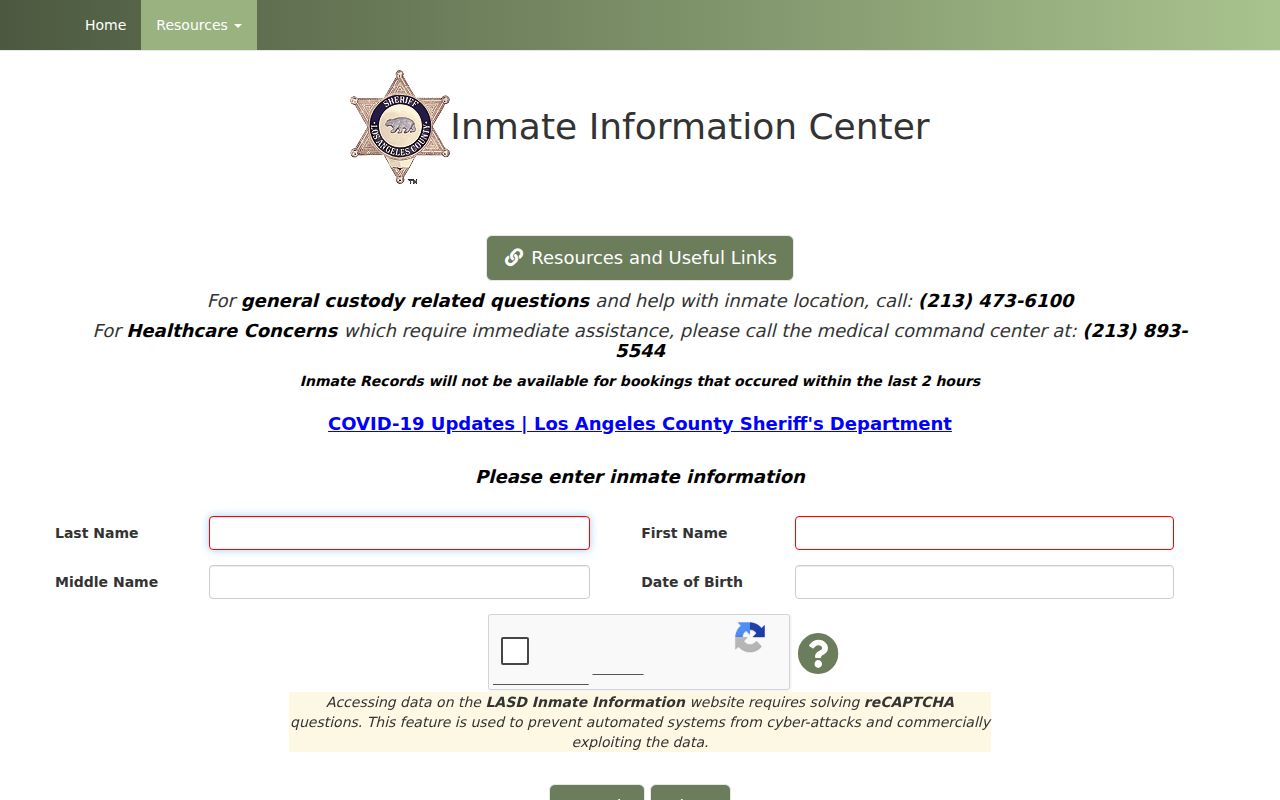
Use custody indexes to confirm current official status, not to infer facts that the record does not state.
Public Records Needing Follow-Up
Some Diamond Bar public records begin online but finish through a counter, mail request, paid copy, archive contact, or agency decision. LA County recorder indexes are office-only. Assessor owner information is not posted online. Court document images may require fees or courthouse access. Vital records have copy eligibility rules. Voter files require a statutory purpose. Older Diamond Bar history often requires library or archive sources because the city did not exist for much of the county record span.
The best fallback is a short chain: identify the custodian, gather the known fields, check the posted portal, then request the specific record. For property, that chain may be address to Assessor to document number to RR/CC copy. For a past resident, it may be city directory to obituary to probate case. For a business, it may be SOS entity to FBN to city license report.
Note: California DROP and data-broker opt-out tools do not erase government public records held by official custodians.